Tag Archive for: Columbus European Mid-Cap Equity

Columbus class I is up 4.5% in December, 9.0% in 2023 and 37.4% in the last 5 years. This was a good end of the year for European midcaps (MSCI Mid Europe: +8% in Q4), and in general for equity markets (Stoxx 600: +6% in Q4), but on the big context for small/midcaps, it was just a bounce after a weak 2022 (MSCI Midcaps: -21%).

In 2023 the small/midcap asset class continued to underperform the US “big 7” stocks, but it was good to see that the year-end rally in bond markets was followed by a good recovery in small/midcaps. We believe there is light at the end of the tunnel for European midcaps, and we also detect that the investment community is starting to pay attention to the space. Recent WSJ article is a good example (“Why Now May Be the Time To Invest in Midcap Stocks” Jan.2024)

The recent bond rally changes everything. Such a material change in trend is very relevant for 2 reasons: 1) Business and families can now finance cheaper than months ago, and it’s not just the cost, the fear of higher rates is a deterrent to take business decisions. Prospects of a more stable rate environment will ease fears and facilitate refinancing. 2) The rates level is the key factor for asset pricing and explains large monetary flows. Short-term monetary funds reached an all-time high in 2023, investors moved quickly into long-term rates in Q4 2023 and partly into midcaps. The alternative of fixed income is less appealing, and we believe there is no other asset class more interesting that high yields in quality smallcap equities. European midcaps continue to offer very interesting valuation levels and relatively good prospects, even if macro prospects continue to be uncertain.

We continue to see deep value in many high-quality companies in Europe which have solid growing cash flow prospects. The opportunity to invest in quality growth companies in Europe is still there, no matter if the macro situation can remain subdued for some time or if inflation does not return to the 2% target for some time.

There is excessive value concentration on the “Big 7” stocks, usually a driver of low returns in the long-term. An open economy requires a large group of companies that respond to economic needs and a good selection of midcaps tends to have better revaluation in the long term than the market average. Market consensus expects the economy to slow down in 2024 and begin a period of rate cuts that may be favorable for bond and equity valuations. The risk of a macro adjustment remains present. In this environment, we are convinced that Columbus’ portfolio is relatively well positioned.

Regarding Columbus portfolio, during the month of December, the return of some stocks stands out. The best performing stocks in December coincide with some companies where we recently increased our stakes such as Mobico (+27%), Prysmian (+17%), YouGov (14%) or Trainline (+13%). If we look at the full year 2023 the best performing stocks included Elecnor, Buzzi, Computacenter, Salcef, EFG International and Auto Trader.

On the negative side, during December financials continued to suffer from lower rates prospects (Unicaja: -13%, SCOR: -9%, Mapfre: -4%). Nevertheless, we retain exposure (c.17% of NAV) to several low-risk financials as current rates will continue to support earnings, value remains very supportive, and we see good earnings momentum particularly in insurance (we own SCOR, Ageas and Hiscox). Stocks that detracted performance in full year 2023 (partly recently recovering) include: Duerr, Mobico.

Over the past 2 months we have been very busy visiting more than 50 companies and made several changes in the portfolio. Recent additions to our portfolio include Kinepolis, an unappreciated growth and transformation story in cinemas, Befesa, a turnaround story in metal recycling, and Fresenius, another deep value turnaround story in pharma. Year 2024 appears to be favorable, despite the first trading days have been complex. The macro-outlook in our view is likely to set the tone, while rates could be supportive. At some point we expect a rerating for quality European midcaps, and we want to be ready to capture its long-term potential.


Download monthly factsheet [PDF]


The Columbus Fund can be purchased through the AllFunds, Inversis and Fundsettle platforms. Columbus has a Master-Feeder structure. The Pareturn GVC Gaesco Columbus European Equity Fund in Luxembourg (master) and the GVC Columbus European Equties FI fund (subordinate). The Luxembourg vehicle offers institutional and retail share classes denominated in euros and sterling.

We are delighted to announce that Bosco Ojeda has joined Columbus. Bosco brings a wealth of experience having worked for over 25 years at UBS, where he held the position of Head of European Small and Midcap Research.

Pareturn Columbus class I is up 8.30% in November, 4.24% in 2023 and 24.5% in the last 5 years. This was a great month for European midcaps (MSCI Mid Europe: +6.4%) and in general for equity markets (Stoxx 600: +6.4%), although it’s just a small bounce after a weak October. The bounce was largely driven by a rally in bonds which experienced one of the best months for the past 40 years. Time will tell if inflation is set to return to central banks goals, but today inflation is no longer the concern it was months ago. Companies, families, and governments can now refinance 80bp lower than at the peak in October and there is a strong feeling that the rates risk is now limited. Money market funds are so heavily overweighted that the inflation change is a massive event. For European midcaps this is a very relevant theme, we see deep value in many high-quality companies in Europe which have solid growing cash flow prospects. The opportunity to invest in quality growth companies in Europe is still there, no matter if the macro situation can remain subdued for some time or if inflation does not return to the 2% target for some time.


The “big 7” (Apple, Amazon, Google, Meta, Microsoft, Nvidia and Tesla) underperformed midcaps this month. There is excessive equity concentration on those stocks, usually a driver of low returns in the long-term. An open economy requires a large group of companies that respond to economic needs and a good selection of small/midcaps tends to have better upside in the long term than the market average. Market consensus expects the economy to slow down in 2024 and begin a period of rate cuts that may be favourable for bond and equity valuations. The risk of a macro adjustment remains present, but rates relief is taking away a big risk of stagnation. In this environment, we are convinced that the Columbus’ portfolio is well positioned.

Regarding the Columbus portfolio, during the month of November, the return of some of the stocks we hold stand out. The 2 best performing stocks this month coincide with companies where we increased our stakes in 2023, including Grifols (+22%) and Elecnor (+16%). In both cases there was a clear catalyst behind the strong performance (asset disposals). A reminder that stocks can be cheap for long, but a good catalyst can revert how the market looks at some companies.
Other stocks that enjoyed a strong performance include Fraport, Prysmian, Neoen and Reply. These are stocks which were penalized despite a solid operating performance, there are quite a few of those in our portfolio that should be heavily rerated. On the negative side, during November a few financials have suffered from lower rates prospects (Unicaja: -6%, Mapfre: -2%, SCOR: -2%). We maintain a moderate exposure to low-risk financials as current rates will continue to support earnings for a while and value remains very supportive.

Over the past 4 weeks we have been very busy visiting more than 40 companies. This is a great time of the year to meet with management teams ahead of 2024. Most companies have good visibility on the budgets for next year and for Columbus is a fantastic opportunity to rebalance the portfolio. We anticipate relevant changes in Columbus over the coming days with fresh new ideas and changes in weightings. November performance can be the tip of the iceberg of a potential rerating for quality European midcaps and we want to be ready to capture its long-term potential.


Download monthly factsheet [PDF]


The Columbus Fund can be purchased through the AllFunds, Inversis and Fundsettle platforms. Columbus has a Master-Feeder structure. The Pareturn GVC Gaesco Columbus European Equity Fund in Luxembourg (master) and the GVC Columbus European Equties FI fund (subordinate). The Luxembourg vehicle offers institutional and retail share classes denominated in euros and sterling.

The month of October has been a difficult month for the stock markets. European equity indices fell between 3.6% for the Stoxx600 index and 5% for the MSCI Midcaps Europe in the month. Stock prices factor in tough macro developments and the highest interest rate environment in a decade. In the US, the Russell 2000 of medium-sized companies also fell 7% in the year to October. Pareturn Columbus class I decreased by -5% in October 2023 and -3.7% year to date. Since its inception in June 2008, it has risen by 114.7%, widely outperforming the European equity indices.

There are three closely related factors that are affecting the markets and specifically midcaps. The first, interest rates, which after one of the most pronounced increases in recent decades, are beginning to show signs of stabilization. The second, macro expectations that until now have shown more strength than expected, but with signs of incipient weakness. Finally, inflation, which, although still high, has been substantially reduced. In this environment, investors have chosen to invest in the money market and short-term duration fixed income and concentrate on the “big 7” (Apple, Amazon, Google, Meta, Microsoft, Nvidia and Tesla). While it is true that consumers and certain trends (e.g. artificial intelligence) are favorable to these names, history shows that excessive concentration in certain stocks ​​is a poor indicator of future returns. The market economy requires a broad group of companies that respond to economic needs and a good selection of securities tends to have better appreciation in the long term than the market average.

For the year 2024 we expect reductions in interest rates, which will be favorable for valuations and risk assets such as equities. In this environment, we are convinced that Columbus’ portfolio is well positioned with high margin, not excessively cyclical companies with healthy balance sheets.

Regarding the Columbus portfolio, during the month of October, the return of companies with good growth expectations stands out, such as YouGov, which presented results and rose 13% in the month, and other securities that had a strong performance, such as Elecnor (+8% ), EFG International (+5%) or Kontron which rose 4%. We particularly highlight YouGov, which rose significantly after publishing results that significantly beat the market expectations. On the negative side, industrial stocks continue to show weakness such as Duerr (-25%), Bodycote (-12%) which are suffering from the increase in costs. In all cases, we expect these companies to recover ​​due to their restructuring plans and potential price increases.

Download monthly factsheet [PDF]


Since May 2023, Spanish investors have been able to access the Columbus strategy through the Spanish GVC Columbus European Equities FI fund. The Fund can be purchased through the AllFunds, Inversis and Fundsettle platforms. Columbus has a Master-Feeder structure: The Pareturn GVC Gaesco Columbus European Equity Fund in Luxembourg (master) and the GVC Columbus European Equties FI fund (subordinate). The Luxembourg vehicle offers institutional share classes denominated in euros and sterling and retail in euros and can be purchased by international investors.

imagen ficha junio

Pareturn Columbus European Equity class I is down -2.37% in September 2023.

The month of September has been a complicated month for the stock markets, dragged down by the behavior of the fixed income markets. The MSCI Midcap index is down -3.00% in September and almost -4% in the last quarter, largely driven by difficulties in controlling inflation and fear of a longer period of high rates.

Since its creation in June 2008, Columbus has obtained a return of 126%, far exceeding European equity benchmarks.

Despite external headwinds, it is interesting to note that relative valuations of European smallcaps are already pricing in tough macro developments and a higher rate environment in the last decade.

The interest rate environment and inflation dynamics are conditioning the market, and it is foreseeable that it will continue to do so. So far, the global economy has been resilient in the face of a sharp rise in rates. The consensus expects the economy to slow down in 2024 and begin a period of rate cuts that may be favorable for bond and equity valuations. However, the risk of a harsh macro adjustment and persistent inflation remains present. In this environment, Columbus’ portfolio is well positioned with high-margin companies and relatively healthy balance sheets.

Regarding the Columbus portfolio, during the month of September, the positive performance of companies with good growth expectations stands out, such as Computacenter (+16% in the month) and Trainline (+20%) and Elecnor (+8.5%). Both Computacenter and Trainline reported quarterly results that positively surprised the market.

On the negative side, Ariston dropped 15% when the structure of the subsidies that the Italian government offers for the replacement of water heaters was modified. We believe that this sharp decline is excessive and do not reflect the good performance of the company after the purchase of the German company Centrotec Climate Systems in Germany last year.


Download monthly factsheet [PDF]


Since May 2023, Spanish investors have been able to access the Columbus strategy through the Spanish GVC Columbus European Equities FI fund. The Fund can be purchased through the AllFunds, Inversis and Fundsettle platforms. Columbus has a Master-Feeder structure: The Pareturn GVC Gaesco Columbus European Equity Fund in Luxembourg (master) and the GVC Columbus European Equties FI fund (subordinate). The Luxembourg vehicle offers institutional share classes denominated in euros and sterling and retail in euros and can be purchased by international investors.

Informe Columbus Septiembre 2020

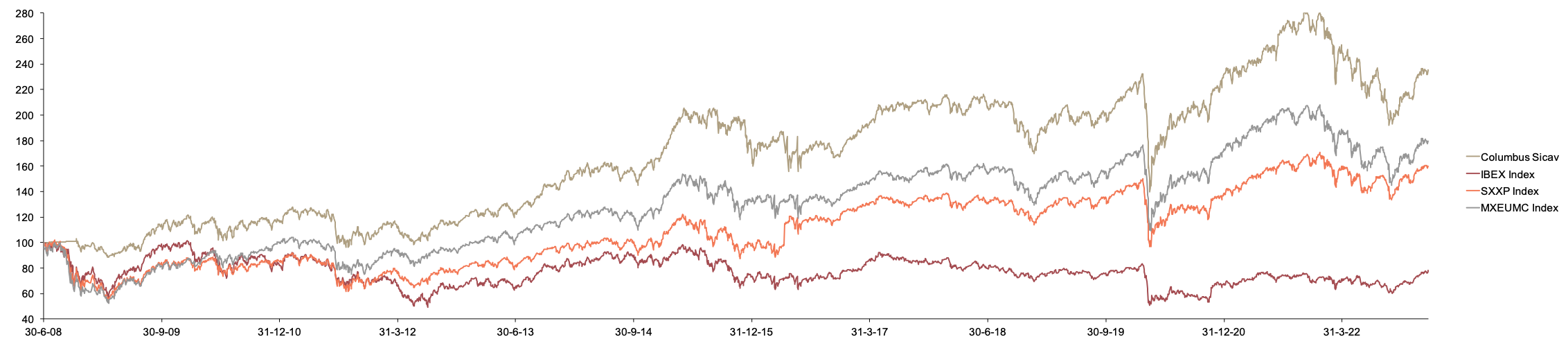
Pareturn Columbus European equities Class I is up by 1.90% in February 2023 and by 9.66% in the last 3 months, higher than the European equity markets. Since inception in June 2008, Columbus has returned 147.4%, far outperforming the European equity markets.

We maintain our view that the key to the behaviour of the markets is the evolution of inflation. It has now peaked and begun its journey to lower levels and the markets have reacted to the upside. Investors are assuming a longer period of higher interest rates as they begin to accept the message from Central Banks that more time is needed to cool inflation in the face of resilient labour markets.

Market sentiment continues to shift depending on whether participants believe the economy is headed for a hard or soft recession. Expectations of where terminal rates end up in the US continue to rise, standing at 5.5% now and moving higher. Since 2012, Central Banks have committed to a 2% inflation target. The appropriateness of the 2% inflation target itself, could be questioned, and we could see changes over the years to a higher target (3%-4%). For the time being, Central Banks are sticking at least verbally to that target.

Chart performance Columbus

As for the quarterly results companies continue to surprise both in sales and profits as they publish their results. Nevertheless, they are moderating their guidance for the coming quarters and the message to control spending is spreading, in anticipation of a slowdown in economic activity.

As for the Columbus portfolio, the main performers during February have been Borregaard (Biochemicals, Norway) up 14.7% after publishing better than expected quarterly results with sales increases of more than 20% and Ebitda up by 38%. Dalata Hotel (Hotels, Ireland) also performed well (+10.9% up in February). The Irish hotel company also announced results that exceed the income of 2019, the last year before the pandemic, by more than 20%. On the negative side, Global Dominion fell on the stock market by -10.8% in February. The Spanish services and projects company surprised the market by increasing its stake in its renewable energy subsidiary from 35% to 98%. The transaction also changes the company’s financial profile by going from a net cash position to having financial debt. We await the presentation of the business plan to obtain more information on the new strategy.


Download monthly factsheet [PDF]


Since June 14, 2018, both national and foreign investors have been able to access the Columbus strategy through the Master-Feeder structure between Columbus 75 Sicav in Spain and the Luxembourg registered Pareturn Columbus European Equities Fund offers institutional and retail share classes denominated in euros. We have also just set up a sterling share class to facilitate investments from the UK. The Spanish Sicav has been dissolved in December 2022 to adapt to the new Spanish legislation. Total return for the Sicav since inception in June 2008 was 113.32%.

Pareturn Columbus European equities Class I is up by 8.80% in January 2023 and by 15.16% in the last 3 months, higher than the European equity markets. Since inception in June 2008, Columbus has returned 142.7%, far outperforming the European equity markets.

We maintain our view that the key to the behaviour of the markets is the evolution of inflation. It has now peaked and begun its journey to lower levels and the markets have reacted to the upside. Investors are assuming a longer period of higher interest rates as they begin to accept the message from Central Banks that more time is needed to cool inflation in the face of resilient labour markets.

Since 2012, Central Banks have committed to a 2% inflation target. The appropriateness of the 2% inflation target itself, could be questioned, and we could see changes over the years to a higher target (3%-4%). For the time being, Central Banks are sticking at least verbally to that target.

A very important development is that Europe has managed to make it through winter so far without severe energy shortages, thanks to above normal temperatures, ample supplies, and reduced consumption. Gas storage sites are around 81% full, some 20 percentage points above the five-year average. The region is on track to end the season with inventories over 50% and more than enough gas to completely replenish its storages by the start of next winter.


Companies continue to surprise both in sales and profits as they publish their results. Nevertheless, they are moderating their guidance for the coming quarters and the message to control spending is spreading, in anticipation of a slowdown in economic activity.

As for the Columbus portfolio, the main performers during January have been Fraport (Frankfurt airport) up 36.8% and Autotrader (+21.6%), the UK second hand car web. The main laggard was Neoen (-8.7%) the French renewable company. The strong price movements were not reactions to specific company news.


Download monthly factsheet [PDF]


Since June 14, 2018, both national and foreign investors have been able to access the Columbus strategy through the Master-Feeder structure between Columbus 75 Sicav in Spain and the Luxembourg registered Pareturn Columbus European Equities Fund offers institutional and retail share classes denominated in euros. We have also just set up a sterling share class to facilitate investments from the UK. The Spanish Sicav has been dissolved in December 2022 to adapt to the new Spanish legislation. Total return for the Sicav since inception in June 2008 was 113.32%.

We maintain our view that the key to the behaviour of the markets is the evolution of inflation. It has now peaked and begun its journey to lower levels and the markets have reacted to the upside.

Pareturn Columbus is up by 9.71% in the last quarter of 2022 in line with European markets. During December it fell by -1.09%, less than markets. During 2022, it fell by -23.2%, the worst year since we started in 2008. Since inception in June 2008, Columbus has returned 123%, far outperforming the European equity markets.

Inflation was the dominant economic and financial issue of 2022 for most countries around the world. Three things seem to have changed as we begin 2023. The first is that inflation is starting to come down globally and, in many respects, has come down faster than markets anticipated. In response to falling inflation, markets have begun to price in peak interest rates from central banks in the last part of this year and in 2024 and beyond. Finally, China has reopened following the end of the Covid restrictions, adding to global economic growth.

Since 2012, Central Banks have committed to a 2% inflation target. The appropriateness of the 2% inflation target itself, could be questioned, and we could see changes over the years to a higher target (3%-4%). For the time being, Central Banks are sticking at least verbally to that target. In this new year, investors will also focus on what kind of recession we get, long or short, and how deep, or if it is simply an economic slowdown and recession has been avoided.

A very important development is that Europe has managed to make it through winter so far without severe energy shortages, thanks to above normal temperatures, ample supplies, and reduced consumption. Gas storage sites are around 81% full, some 20 percentage points above the five-year average. The region is on track to end the season with inventories over 50% and more than enough gas to completely replenish its storages by the start of next winter.

We have transitioned into a new investment era over the last 12-18 months. The post-global-financial-crisis “free money era”, which supported outperformance from growth, technology, and US equities, has ended. The brave new world which investors face supports the return of price to the centre of the investment process.

For equity investors, we view Europe as better placed relative to US equities, with support from valuation for similar growth profiles and a soft US dollar. Europe also has greater exposure to China re-opening. We would also consider growth or quality at a reasonable price. It’s an evolution that makes the global economy and investment portfolios subject to a wider range of potential outcomes.

As for the portfolio, the main performers during the quarter have been Durr AG (+49.9%), a German industrial company; Scor SE (+45.8%) reinsurance provider and Elementis (+33.4%) a supplier of raw materials. Detractors were the bus company National Express (-22.9%) and the digital services company Reply (-0.5%). The strong price movements were not reactions to specific company news.


Download monthly factsheet [PDF]

We thank you for your trust and wish the best to you and your families during these uncertain times.


Since June 14, 2018, both national and foreign investors have been able to access the Columbus strategy through the Master-Feeder structure between Columbus 75 Sicav in Spain (feeder) and the registered Pareturn GVC Gaesco Columbus European Midcap Equity Fund in Luxembourg (master). The Luxembourg vehicle offers institutional and retail share classes denominated in euros. We have also just set up a sterling share class to facilitate investment from the UK. The Spanish Sicav was dissolved to adapt to the new Spanish legislation. Total return for the Sicav since inception in June 2008 was 113.32%.

September ends with sharp drops in the equity market. The stock market’s status quo, has not fundamentally changed. Everything is still focused on inflation. The message from the central banks has been clear: The priority is to control inflation, even at the cost of sacrificing more growth and employment. In recent weeks, this has led to increased expectations of further interest rate hikes, and the conviction that these will remain high for longer.

Pareturn GVC Gaesco Columbus European Equity Fund Class I fell 10.63% during September, worse than European stock markets. Since its inception in June 2008, Columbus has returned 103.38%, far outperforming European equity indices. The volatility during the last twelve months has been 20%.

We continue to think that the key to the behaviour of the markets is the future evolution of inflation. The falls we have seen in the price of oil and other raw materials, as well as the easing of supply chain disruptions and improvements in freight prices should result in lower inflation. We believe that these decreases will begin to materialize in the last quarter of this year and especially in 2023 when last year’s energy increases will fall out of the calculation.

In many aspects, the fundamentals remain favourable: labour demand is at record levels both in the US and Europe, the financial system is well capitalized, families have high levels of savings accumulated during the pandemic, companies have not increased their productive capacity. Nevertheless, growth in 2023 will be weak with a growing risk of recession, especially in Europe (late 2022-early 23) and in the US next year.

As for the portfolio, the fund underperformed the market over the month, with many companies falling sharply, with no news on individual stocks. Highlights, on the positive side:

  •   Ariston (+17.06% in September). The Italian heater company announced the purchase of Centrotec Climate Systems GmbH. The acquired company is a world leader in heat pumps. It is an acquisition that complements the range of Ariston products and allows entry into other segments such as ventilation.
  •   Krones (+10.35%). The German bottling machinery company raised its expected sales guidance for this year, while hoping to maintain its margins. During the month, we also completed the sale of VGP, Safestore and Dormakaba.

We reiterate what we said last month: we think that stock markets will react positively when we start to see better inflation data, in the last quarter of this year and in the first quarter of next year. European equity valuations are below their average valuations in recent years, mutual funds have increased their cash levels dramatically and investor pessimism is at its highest level since 2009. All of these are positive indicators for future stock behaviour. We do not know if it is the best time to buy but it is a good time.


Download monthly factsheet [PDF]

We thank you for your trust and wish the best to you and your families during these uncertain times.


Since June 14, 2018, both national and foreign investors can access the Columbus strategy through the Master-Feeder structure between Columbus 75 Sicav in Spain (feeder) and the registered Pareturn GVC Gaesco Columbus European Midcap Equity Fund in Luxembourg (master). The Luxembourg vehicle offers institutional and retail share classes denominated in euros. We have also just set up a sterling share class to facilitate investment from the UK.

The state of the stock market, fundamentally, has not changed. Everything is still focused on inflation. The message from the central banks in Jackson Hole has been clear: The priority is to control inflation, even at the cost of sacrificing more growth and employment. In recent weeks, this has led to expectations of further increases in interest rates and the belief that these will remain high for longer.

Pareturn GVC Gaesco Columbus European Equity Fund Class I was down 5.54% in August in line with markets. Over the last three years it has risen 14.26%. Since its inception in June 2008, Columbus has returned 127.50%, far outperforming European equity indices. The volatility during the last year has been 18%.

Performance Columbus Fund

The market now expects the Fed to raise rates to 4.75% in early 2023, instead of the previous 4.5%, and both the Bank of England and the ECB to raise rates to 3.25% and 2.25% respectively from the expected rates of 2.0% and 1% from before summer.

In many respects, the fundamentals remain favourable: labour demand is at record levels in both the US and Europe, the financial system is well capitalized, families have high levels of savings accumulated during the pandemic, and companies have not increased their productive capacity. However, growth in 2023 will be weak, with a heightened risk of recession, especially in Europe (late 2022-early 23), which will begin to materialize after the summer, given the energy shortage.

We continue to think that the key to the behaviour of the markets is the future evolution of inflation. The falls we have seen in the price of oil and other raw materials, as well as the easing of supply chain disruptions, such as improvements in freight prices, augur drops in inflation, which will begin to materialize in the last quarter of this year and especially in 2023, when last year’s energy increases fall out of the calculation.

We reiterate what we said last month: stock markets will react positively when we start to see better inflation data in the last quarter of this year and in the first quarter of next year. European equity valuations are below their average valuations in recent years, mutual funds have increased their liquidity levels dramatically and investor pessimism is at its highest level since 2009. All these are positive indicators of future stock behaviour.

Download monthly factsheet [PDF]

We thank you for your trust and wish the best to you and your families during these uncertain times.


Since June 14, 2018, both national and foreign investors can access the Columbus strategy through the Master-Feeder structure between Columbus 75 Sicav in Spain (feeder) and the registered Pareturn GVC Gaesco Columbus European Midcap Equity Fund in Luxembourg (master). The Luxembourg vehicle offers institutional and retail share classes denominated in euros. We have also just set up a sterling share class to facilitate investment from the UK.
.

Pareturn GVC Gaesco Columbus European Equity Fund class I rose by +6.20% in July. In the last twelve months, the Fund fell by -12.65% but its 3-year performance remains strong at +20.21%. Since its inception in June 2008, Columbus has returned +140.93%, far outperforming European equity indices. The volatility in the last 12 months has been 16%.

The European Central Bank’s first interest rate rise in 8 years took place in July. The US Federal Reserve also raised interest rates again by 0.75pp, to 2.5%. These increases in interest rates have pushed down the yield on 10-year government bonds by almost 1pp from the maximum marked last month. The markets have already priced in the belief that these interest rate changes will suppress inflation whilst also causing a recession, which we believe will not be severe.

We continue to believe that the key to the market’s behavior is the future evolution of inflation. The dips we have seen in the price of oil and other raw materials, as well as the easing of supply chain disruptions, such as improvements in freight prices, hint toward inflation drops, which will materialize in the last quarter of this year and especially in 2023. We reiterate what we pointed out last month: we believe there will be a bullish stock market reaction once inflation data begins to improve. Finally, we also note that fixed income markets are anticipating falls in interest rates next year and that mutual funds continue to hold very high levels of cash. Both are positive aspects for future stock market performance.

Listed companies’ first half results had a positive impact on global stock markets, which have now recovered part of the losses suffered in the first half of the year. The published results of the companies show double-digit growth in sales and a narrowing of margins derived from cost increases in some sectors, but which still allow profits to grow. Only a quarter of the companies in the markets have published lower than expected results.

Three companies stood out in the Columbus portfolio this month:

  • You Gov (+26.2% in July): The British online data analysis company increased revenues by 28% in the first half of the year whilst establishing healthier margins. The growth of their American business was the principal source of the top-line re-acceleration. Management does not appreciate any changes in customer behavior due to the macroeconomic situation.
  • Senior Plc (+23.2% in July): The British industrial components company increased revenues by 21% in the first half of the year, also with healthier margins. Moreover, they announced they will be distributing dividends again.
  • Neoen (+18.3% in July): The French renewables company income grew by 36% more and showed a 39% improvement in EBITDA. The company also increased its earnings guidance for this year.

Unfortunately, there was negative news from Scor SE. Due to losses associated with climate change, the French reinsurance company posted worse-than-expected results in its Property & Casualty business. In November, they will present a plan to reduce their exposure to this sector. The stock has a dividend of close to 10% with very attractive valuations. We remain positive on its value given the valuation and upcoming restructuring.

The markets are changing rapidly so we believe it is crucial to mold our portfolio to the new reality. The retreat of globalization, and the return of inflation, economic cycles and volatility will mark the markets in the future. Since the last great crisis, now more than 10 years ago, lower growth has been a signal to buy risky assets since, generally, an increase in liquidity was generated by the Central Banks. Investors got used to an environment in which equity and bond markets were negatively correlated, while Central Banks increased liquidity if economic activity deteriorated. We think this will be less likely going forward, as Central Banks assess the risks of increasing liquidity versus higher inflation. We also believe that equity markets will once again factor in more frequent business cycles. All this will generate opportunities for active management, like ours, to add substantial value to our clients.


Download monthly factsheet [PDF]

We thank you for your trust and wish the best to you and your families during these uncertain times.


Since June 14, 2018 both domestic and foreign investors have been able to access the Columbus strategy via the master-feeder structure between the Columbus 75 Sicav in Spain (feeder) and the Luxembourg registered Pareturn GVC Gaesco Columbus European Midcap Equity Fund (master). The Luxembourg vehicle offers both institutional and retail share classes.